
Red Flags When a Factory Quotes a Scented Haircare Line
Red flags in a scented haircare project rarely announce themselves as red flags. They arrive as a fast quote, a confident answer and a price that is lower than the others. The signals that matter are usually omissions rather than errors: nothing about the base the fragrance will sit in, nothing about stability, nothing about restricted materials. Reading a quote for what is missing is a more useful skill than comparing the numbers.
Key takeaways
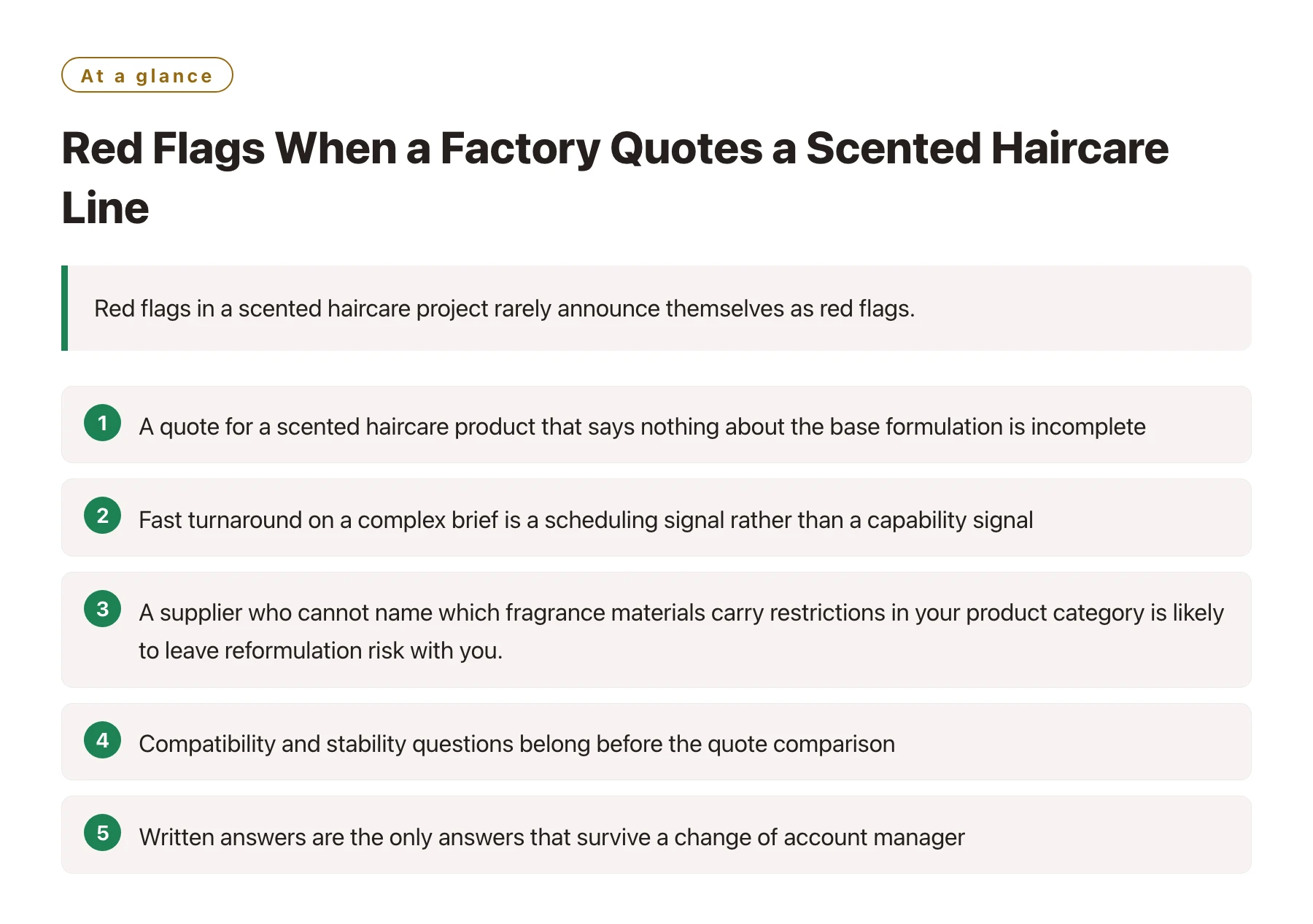
- A quote for a scented haircare product that says nothing about the base formulation is incomplete, because surfactant systems change how a fragrance reads and ages.
- Fast turnaround on a complex brief is a scheduling signal rather than a capability signal; ask how many sample rounds are included.
- A supplier who cannot name which fragrance materials carry restrictions in your product category is likely to leave reformulation risk with you.
- Compatibility and stability questions belong before the quote comparison, not after the sample is approved.
- Written answers are the only answers that survive a change of account manager, so keep the technical correspondence with the project file.
Scenting a haircare line is technically harder than scenting an alcohol-based fine fragrance, because the fragrance has to perform inside a formulation built for something else. Surfactants, water, salt, preservatives, pH and viscosity all interact with the aroma materials, sometimes in ways that only appear weeks after filling.
That is why a quote for a scented shampoo is a different document from a quote for a perfume. It should acknowledge the base, the process and the testing that the base implies.
What follows is a list of what a haircare fragrance quote should contain, and what its omissions tend to mean.
What a scented haircare quote has to contain
At minimum, a usable quote identifies the fragrance direction or reference, the intended dosage range, the base or product type it will be used in, the number of sample rounds included, the unit price at the relevant volumes, and the documents that will be supplied with the bulk. Anything less and the buyer is comparing numbers attached to different scopes.
It should also say who does the compatibility work. A fragrance house that expects the brand to test compatibility in a base it has never seen is offering a material, not a solution. An an OEM partner for perfume brands that formulates and fills in one place is usually able to answer the compatibility question directly, because the same organisation controls the base and the scent.
Dosage deserves a second look. A quote that gives one dosage figure without a range is implicitly claiming that the same load works across a shampoo, a conditioner and a hair oil. In practice those three bases carry fragrance very differently, and a supplier who does not distinguish them is likely to have quoted from a template.
What the quote says, and what that may be hiding
| What the quote says | What may be missing | Question that closes the gap |
|---|---|---|
| A price per kilogram of fragrance compound | The dosage assumed in that price | At what percentage is this price calculated, and what is the range you would recommend? |
| A lead time for the fragrance | Whether stability and compatibility testing is included in that time | What testing happens before the bulk is released, and who pays for it? |
| A statement that the formula is compliant | Which restricted materials were checked and against which limits | Which materials in this formula carry restrictions in a rinse-off haircare product? |
| A sample offer with no round count | How many revisions are included before extra charges apply | How many sample rounds are in the price, and what does another round cost? |
| A very low unit price | The grade of the base, the packaging or the fill tolerance | What exactly is included at this price, item by item? |
| A quick yes to every requirement | Whether a technical review actually took place | Which part of this brief would you push back on, and why? |
The last row is the most informative. A supplier with real technical depth almost always has something to disagree with, and the way they disagree tells you how the project will run.
Base compatibility is the technical core
A fragrance compound is a mixture of materials with different solubility, volatility and reactivity. Put that mixture into a surfactant-rich shampoo and some materials will be solubilised differently, some will be masked by the base odour, and some may discolour or lose intensity over time. None of this is visible on a blotter.
Restricted-material limits add a second constraint. The IFRA Standards Library publishes restrictions by material and by product category [1], which means the same accord can have a different practical ceiling in a rinse-off shampoo than in a leave-on hair oil. A supplier who can explain that difference is working from the standards; one who cannot is likely to discover it during scale-up.
The EU Scientific Committee on Consumer Safety provides the scientific advice that underpins much of the European framework for cosmetic ingredients, including fragrance allergens [2]. A buyer does not need to read the opinions, but knowing that the framework is based on published safety assessment makes it easier to ask the right question: which materials in this formula are subject to a limit, and by how much are we inside it?
Material-level information is normally available from the fragrance houses that supply the industry. Large houses such as dsm-firmenich publish information about their materials and their approach to sustainability, which is one way a new brand can learn how materials are described and classified [3].
Documentation red flags
A quote that promises a compliant product without naming a single document is a promise, not a deliverable. The minimum pack for a scented haircare line includes the fragrance specification, a safety data sheet, allergen information for labelling purposes, and a statement of which restricted materials were assessed and to what limits.
Watch for documents that are offered only after the order is placed. Speculative requests made during quoting are normally answered quickly, because the supplier wants the business. A credential that cannot be produced before the purchase order is often one the supplier has to obtain from somebody else.
The most useful red flag is not a missing document at all; it is a technical answer that arrives with no source. When a supplier states a limit, a dosage or a testing outcome, ask what it is based on. A partner that can point to a standard or a test report is easier to build a range with, which is the real question behind custom fragrance R&D and production.
Put the compatibility question in writing before you compare prices. Two quotes that look comparable are often not, because one includes base testing and one assumes the brand will do it. Resolving that single difference early prevents the most common first-order surprise.
Sources
- IFRA Standards Library (International Fragrance Association) —— The IFRA Standards Library lists the restrictions the fragrance industry applies to individual fragrance ingredients, based on safety assessments; it is the reference point for compliant fragrance formulation.
- EU Scientific Committee on Consumer Safety (SCCS) —— The EU scientific committee that issues opinions on the safety of cosmetic ingredients, including fragrance allergens and their labelling thresholds.
- dsm-firmenich —— A global fragrance, flavour and nutrition company; public information on perfumery, ingredients and sustainability programmes.
Frequently asked questions
Why is scenting shampoo harder than scenting perfume?
An alcohol-based fragrance is a comparatively simple carrier. A shampoo or conditioner contains surfactants, water, salts, preservatives and pH adjusters, all of which can change how the fragrance is perceived, how stable it is and how it colours over time. The fragrance has to be tested in the real base.
What should a first scented haircare quote include?
The fragrance direction, the recommended dosage and range, the base it is intended for, the number of sample rounds, the unit price at your volumes, the testing included and the documents supplied with bulk. If any of those are absent, ask before comparing prices.
Is a cheap fragrance quote always a warning sign?
Not by itself, but a price much lower than comparable quotes usually means something has been excluded: testing, a higher dosage assumption, a different base grade or a lower fill tolerance. Ask what is included at that price before drawing a conclusion.
How do I know a fragrance is compliant for a haircare product?
Ask which restricted materials in the formula were assessed, against which limits, and for which product category. Rinse-off and leave-on haircare products are treated differently, so the category has to be stated explicitly, not assumed.
Should stability testing be quoted separately?
It can be, as long as it is visible. What causes trouble is stability work that is neither quoted nor mentioned, leaving the brand to assume it was included. Ask directly whether compatibility and stability testing are part of the offer.
Siap Memulai Transformasi Digital?
Konsultasi gratis 30 menit dengan arsitek solusi senior kami. Tanpa komitmen, tanpa biaya tersembunyi — hanya peta jalan yang jelas untuk infrastruktur TI Anda.